
At its heart, blockchain technology is like a digital notebook that’s shared across thousands of computers. Every new entry is permanent and visible to everyone in the network, which gives us a completely transparent and tamper proof way to record information without a central authority, like a bank, overseeing everything.
Getting to Grips with Blockchain Technology
Picture a group project where everyone has a live copy of the same document. Instead of one person holding the master file and being the single source of truth, any change one person makes instantly appears on everyone else’s copy. This simple idea stops any one person from secretly altering the history of the work and keeps the whole team perfectly in sync. Blockchain works on that same principle of shared, synchronised information.
That shared document is what we call a distributed ledger. Because it’s not stored in one central location, it’s incredibly resilient. To actually bring it down, you’d have to shut off every single computer on the network at the exact same time, a virtually impossible task. This decentralised structure is precisely what makes the system so secure and trustworthy.
The Building Blocks of Trust
Every transaction or piece of data gets bundled into a “container” called a block. It helps to think of a block as a single page in our shared digital notebook. Each page is filled with a list of recent transactions, and once it’s full, it gets a unique seal of approval and is added to the notebook for good.
This seal is actually a cryptographic link that connects it directly to the previous page, forming a chronological chain of blocks. And that’s exactly where the name “blockchain” comes from. Trying to alter an old block would be like trying to secretly change a sentence on a page in the middle of a physical book; you’d have to rip out and perfectly rewrite every single page that came after it, an alteration the rest of the network would spot and reject immediately.
A blockchain is essentially a digital ledger of transactions that is distributed across a network of computer systems, each holding an exact replica of the ledger. The technology can be used to transfer value in a secure way, without the need of an intermediary.
To really understand what makes blockchain work, it helps to break it down into its three core components.
The Three Pillars of Blockchain Technology
| Concept | Simple Analogy | What It Does |
|---|---|---|
| Distributed Ledger | A shared Google Doc | Ensures everyone has the same, up to date copy of the transaction history. |
| Immutable Blocks | Pages glued together in a book | Secures transactions in a permanent, unchangeable chain, preventing fraud or edits. |
| Decentralisation | A leaderless group project | Removes the need for a central authority (like a bank) by letting the network agree on what’s true. |
These three pillars work together to create a system that’s transparent, secure, and doesn’t rely on a single point of failure.
A Network of Equals
The final key ingredient is the decentralised network itself. No single person or company owns the blockchain. Instead, it’s maintained by a global community of users, often called “nodes”. This community collaborates to validate and approve new blocks before they can be added to the chain.
This group verification process is what gets rid of the need for traditional middlemen like banks or governments to certify transactions. It creates a system built entirely on collective agreement. This foundation, a distributed ledger, chained blocks, and a decentralised network, is what makes blockchain such a powerful new way to record and verify information.
How a Blockchain Actually Works
To really get your head around blockchain, it helps to follow a single transaction from the moment it’s created to when it becomes a permanent record. Let’s say you want to send some digital currency to a friend. The whole thing plays out across a network of computers, all working in concert to make sure every detail is secure, verified, and can never be changed. It’s a clever system that builds trust without a central boss calling the shots.
When you kick off a transaction, your request is bundled up with a bunch of others and broadcast out to everyone on the network. Think of it like pinning a note on a public notice board for all to see. Every computer on the network, known as a node, sees this notice and starts checking if it’s legitimate. This community led verification is the first line of defence against any dodgy business.
This visual breaks down the basic flow, from a transaction being recorded, bundled into a block, and then added to the chain.
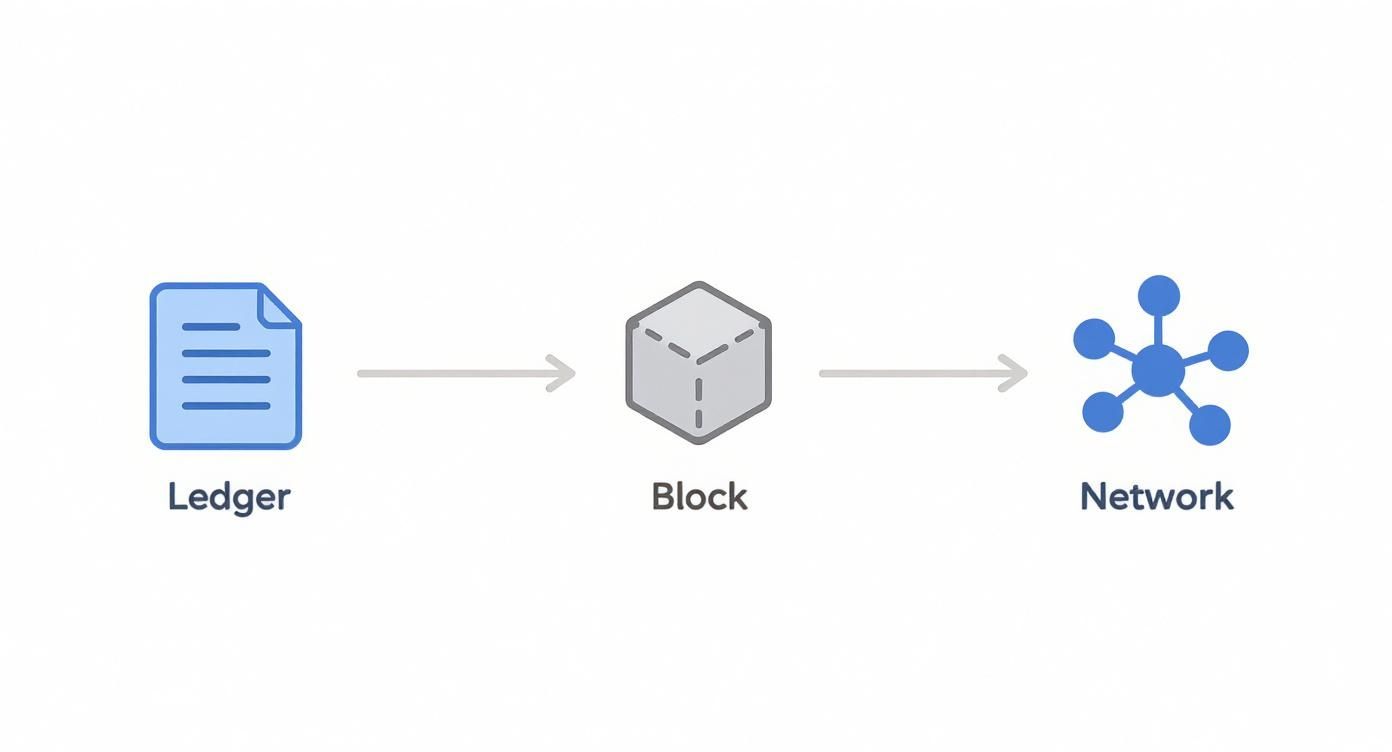
The infographic shows the core idea quite well: individual records are locked into blocks, which are then shared across the network to be validated by everyone.
Creating a Digital Fingerprint
Once a group of transactions is gathered, they’re put into a brand new block. This block doesn’t just hold the transaction details; it also gets a unique digital fingerprint called a hash. A hash is generated by a cryptographic algorithm (like SHA-256) that takes any amount of data and turns it into a fixed length string of letters and numbers.
Here’s the clever part: even the tiniest change to the original data, like altering a single comma in a transaction, will produce a completely different hash. This extreme sensitivity is what makes the whole system so secure. The hash of the new block also cleverly incorporates the hash of the block that came right before it.
This linking of hashes is what creates the “chain” in blockchain. Each block essentially points back to the one before it, forging an unbreakable, chronological record. If anyone tried to tamper with an old transaction, the hash of that block would change, instantly breaking the link to every single block that came after it. The rest of the network would spot this inconsistency in a heartbeat and reject the fraudulent change.
Reaching a Consensus
So, how does the network agree on which new block is the correct one to add to the chain? This is where a consensus mechanism steps in. It’s simply a set of rules that all the computers on the network agree to follow to validate new blocks.
The most well known consensus mechanism is Proof of Work (PoW), the system that powers networks like Bitcoin. In a PoW system, powerful nodes called “miners” compete to solve an incredibly difficult mathematical puzzle.
- The Puzzle: Miners throw massive amounts of computing power at the problem, racing to be the first to find the solution.
- The Winner: The first miner to crack the puzzle gets the right to add their new block of transactions to the chain.
- The Reward: For all that hard work, the winning miner is rewarded with newly created cryptocurrency and transaction fees.
This process is difficult and energy intensive by design. It ensures that no single person or group can easily take control of the network or rewrite history. The cost of trying to cheat the system is just too high compared to the potential reward, which keeps everyone honest.
By forcing participants to spend real world resources (electricity and computing power), Proof of Work makes the blockchain incredibly secure and resistant to attack. It’s a system where trust is earned through verifiable effort, not just handed out by a central authority.
This entire sequence, from broadcasting a transaction to adding it to a block through consensus, happens over and over again. It creates a ledger that is constantly growing, completely secure, and transparently maintained by its own community of users. This is the engine at the heart of blockchain, and it’s how the technology builds trust in a world without middlemen.
The Power of Smart Contracts
Blockchains do more than just keep a record of who sent what to whom. They can also run tiny, self executing programs called smart contracts, and this is where things get really interesting.
Imagine a high tech vending machine. You put your money in, select a snack, and the machine automatically drops it for you. There’s no shopkeeper, no one to argue with, the rules are coded right into the machine. A smart contract is just like that, but for digital agreements.
The terms are written in code and stored on the blockchain. Once the conditions are met, the contract runs itself. This means you don’t always need lawyers, banks, or other middlemen to make sure things happen as they should. It’s automatic, transparent, and unstoppable.
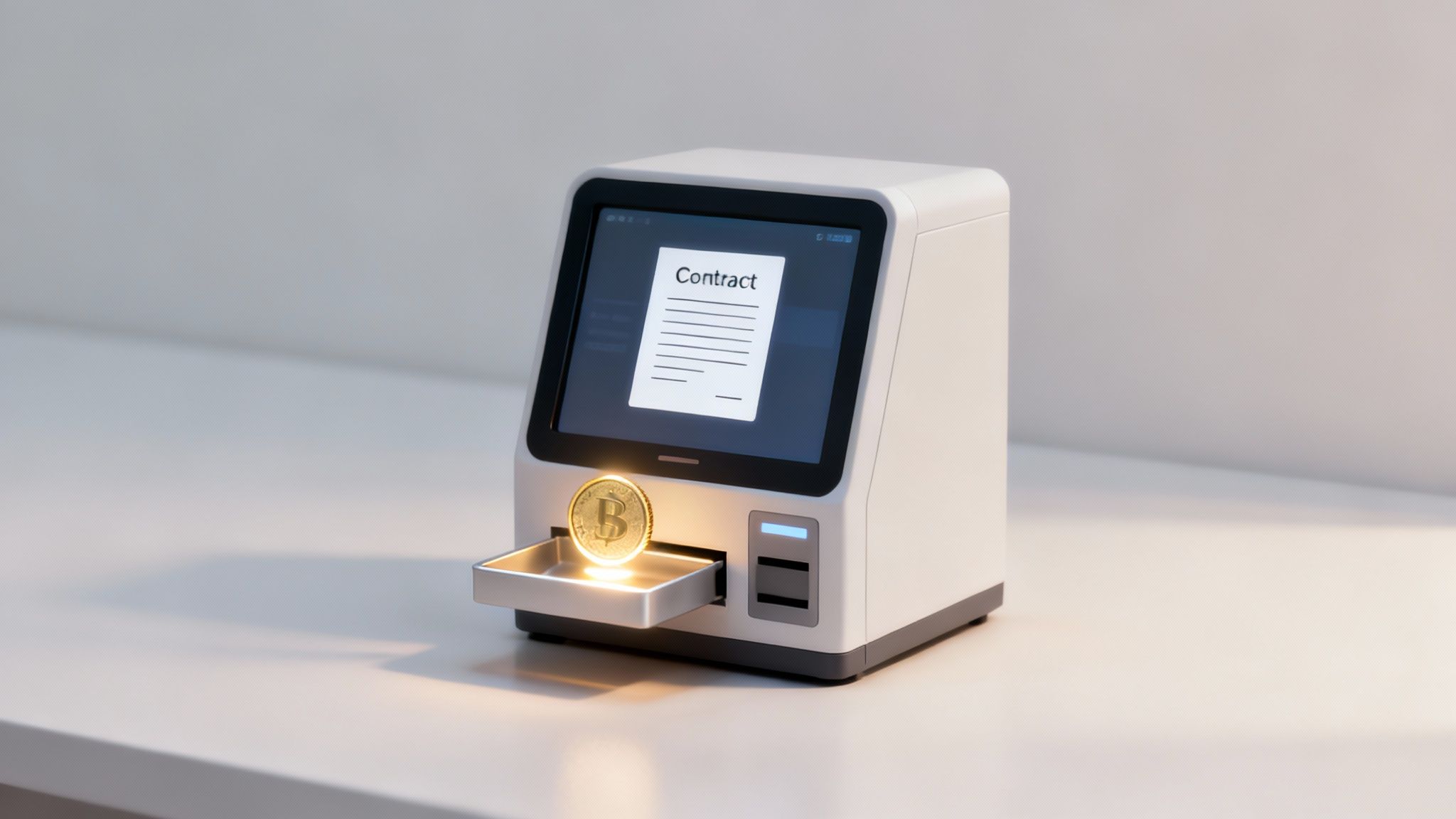
This simple idea, “if this happens, then do that”, unlocks a huge range of possibilities for building trust directly into digital systems.
The Engine Behind The Code
Of course, this code needs somewhere to run. That’s where a virtual machine comes in. For blockchains like Ethereum, this is the Ethereum Virtual Machine (EVM). Think of it as a massive, shared computer that is run by every single node in the network.
The EVM is what actually reads and executes the instructions in a smart contract. Because every computer on the network runs the same calculation and gets the same result, the whole system can agree on the outcome without needing a central boss. This shared processing power is the magic that makes decentralised applications (dApps) work.
A smart contract is a computer program or a transaction protocol which is intended to automatically execute, control or document legally relevant events and actions according to the terms of a contract or an agreement.
These dApps can do anything from handling loans to powering digital art markets. If you want to see a prime example, our comprehensive NFT guide explains how smart contracts are used to prove who owns a unique digital item.
Automating Digital Agreements in Practice
The practical uses for smart contracts are already popping up everywhere. They are the backbone of almost every exciting development in the blockchain world.
Here are just a few examples of what they can do:
- Decentralised Finance (DeFi): Automating lending, borrowing, and trading without a traditional bank in sight.
- Supply Chain Management: Releasing a payment automatically the moment a shipment’s GPS confirms it has arrived.
- Digital Identity: Giving you control over your personal data, letting you grant access to services without a central authority holding the keys.
- Gaming and Collectibles: Creating unique in game items (NFTs) that you actually own and can sell or trade on open markets.
These coded agreements are the fundamental building blocks for a more transparent and automated digital future. For anyone who’s curious about getting their hands dirty, resources that show you how to build smart contracts are becoming more accessible every day. They are what elevates a blockchain from a simple ledger into a true platform for innovation.
Exploring the Different Flavours of Blockchain
It helps to think of blockchains like different types of databases, each built for a specific job. They aren’t all the same, and knowing the differences is crucial to understanding why a project might pick one over another. The decision usually boils down to a simple question: who gets to play?
Public Blockchains: Open to Everyone
The ones you hear about most often are public blockchains. Bitcoin and Ethereum are the big players here. Think of them as a massive, open source project that anyone in the world can join. You don’t need permission to participate, view the entire history of transactions, or even help run the network.
This complete openness is their superpower. It creates an incredibly robust and censorship resistant system because there’s no single person or company in charge. The flip side? This commitment to decentralisation can sometimes mean slower speeds and higher transaction fees, as getting a global network to agree on everything takes time and energy.
Private Blockchains: A Walled Garden
On the other end of the spectrum, you have private blockchains. These are more like a company’s internal intranet, access is strictly by invitation only. A single organisation calls the shots, deciding who gets in and what they’re allowed to do.
This controlled environment is ideal for businesses wanting to use blockchain for internal record keeping, like tracking goods in a supply chain, without putting their sensitive data on a public ledger. Because the network is small and tightly managed, transactions are lightning fast and cheap. The trade off, of course, is you’re placing your trust in the entity that runs it, giving up the “trustless” nature of a public chain.
While public blockchains build trust through mass participation, private blockchains build it through controlled access and accountability within a known group.
This is a key distinction. For a deeper dive, it’s worth exploring the differences between blockchain networks to see how the architecture impacts the use case.
Consortium Blockchains: The Best of Both Worlds?
Then there’s the middle ground: the consortium blockchain. Imagine a private club where a handful of members share the responsibility of running the place. Instead of one company, a pre selected group of organisations (say, a group of banks or logistics firms) governs the network.
This hybrid approach tries to strike a balance. It’s more decentralised and trustworthy than a private chain run by a single entity but more efficient and scalable than a fully public one. It’s a great fit for industry collaborations where partners need to share data securely and efficiently. For example, gaming studios might form a consortium to manage in game assets across different platforms, a concept you can read more about in our look at Web 3.0 gaming models and trends.
To make this even clearer, let’s break down the key characteristics in a table.
Public vs Private vs Consortium Blockchains
| Feature | Public Blockchain | Private Blockchain | Consortium Blockchain |
|---|---|---|---|
| Accessibility | Anyone can join (Permissionless) | Invitation only (Permissioned) | Pre selected group can join (Permissioned) |
| Control | Fully decentralised, no single owner | Controlled by a single organisation | Governed by a group of organisations |
| Speed & Cost | Slower and can be expensive | Very fast and low cost | Faster and cheaper than public chains |
| Security | Extremely high, secured by mass participation | High, but relies on trusting the central entity | High, secured by consensus among known parties |
| Use Cases | Cryptocurrencies (Bitcoin), dApps (Ethereum) | Supply chain, internal audits, data management | Inter bank transfers, industry collaborations |
Ultimately, there’s no “best” type of blockchain, only the right one for the job. The choice hinges entirely on the project’s specific needs for transparency, privacy, speed, and control.
Blockchain Technology in the Real World
The ideas behind blockchain can feel a bit abstract at first, but its impact is already being felt far beyond the world of finance. This isn’t just theory anymore; it’s actively creating new ways for people to own digital items, for companies to connect with customers, and for entire industries to build more transparent systems.
So, where is this technology actually showing up today? The most visible shift has been in digital ownership, thanks to Non Fungible Tokens (NFTs). The simplest way to think of an NFT is as a unique digital certificate of authenticity, securely stored on a blockchain.
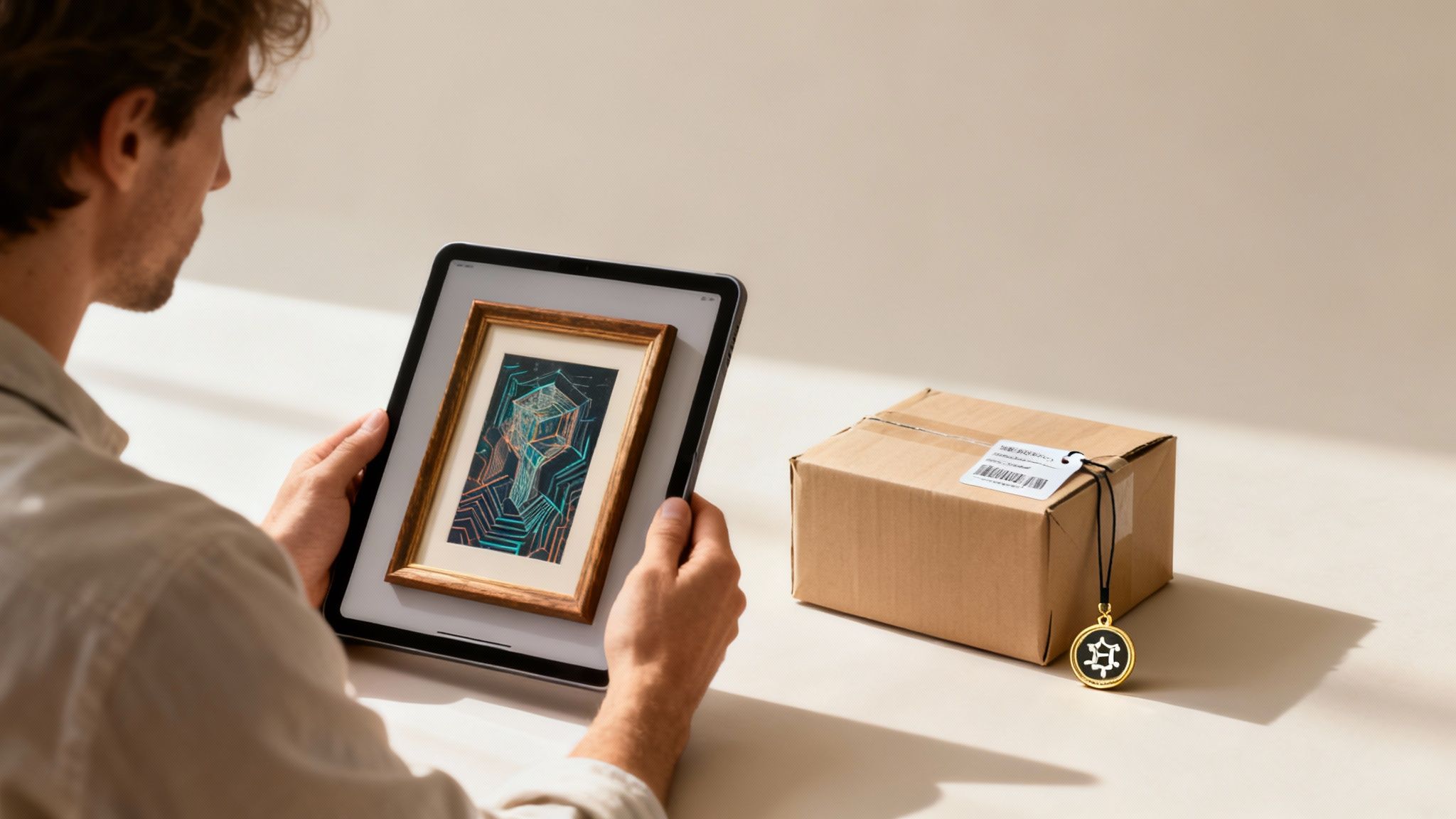
This digital certificate can be attached to just about anything: a piece of art, a song, or even a ticket to an event. Before NFTs, proving you were the true owner of a digital file was nearly impossible because anyone could make a perfect copy. Blockchain fixes this by creating a public, verifiable record that essentially says, “this specific digital item belongs to this person.”
Creating Provable Digital Ownership
This has been a complete game changer for digital artists and creators. They can now sell their work directly to collectors, knowing that the ownership is permanently recorded and can’t be disputed. For collectors, it means they can buy, hold, and sell digital assets with the same confidence they would have with physical items. The blockchain acts as a global, always on art gallery and auction house rolled into one.
This new form of ownership is also powering some really unique community experiences. Brands are now using NFTs as more than just collectibles; they’re becoming digital keys that unlock special perks.
A verifiable digital item can act as a membership pass, giving owners access to exclusive content, private events, or early product releases. It turns a simple purchase into a long term relationship with a community.
For example, a fashion brand might release a limited edition digital wearable as an NFT. Owning it might grant you access to a virtual fashion show or a discount on physical merchandise. This creates a direct and engaging link between the brand and its most loyal fans, building a community around shared digital ownership. Exploring how brands can use blockchain technology reveals just how deep this new form of marketing can go.
Building Transparent and Efficient Systems
Beyond the exciting worlds of art and marketing, blockchain is quietly making a difference in less glamorous but equally important industries. Its ability to create a shared, unchangeable record is perfect for solving long standing problems of trust and transparency.
Here are a few practical examples of blockchain at work:
- Supply Chain Management: Imagine scanning a QR code on a bag of coffee and seeing its entire journey, from the farm in Colombia right to your local shop. Companies like Walmart and Nestlé are using blockchain to track products. This helps ensure authenticity and improve food safety by making every step of the supply chain visible to everyone involved.
- Secure Voting Systems: In any election, trust is everything. Blockchain offers a way to build voting systems where each vote is recorded as a secure, anonymous transaction on a distributed ledger. This could make the results completely transparent and verifiable by the public, dramatically reducing the potential for fraud or tampering.
- Healthcare Records: Your medical history is incredibly sensitive and often fragmented across different clinics and hospitals. A blockchain based system could give you a single, secure record of your health data that you control completely. You could then grant temporary access to doctors or specialists as needed, ensuring both privacy and seamless care.
From verifying the origin of a diamond to simplifying cross border payments, the applications are growing every day. What ties all these uses together is the core idea of creating a single source of truth that multiple parties can trust, without needing a central authority to oversee everything. That’s the real power of this technology in action.
How Blockchain Solves Real Economic Problems
While most of the chatter around blockchain seems to focus on price charts and speculation, its real power is quietly surfacing where traditional economic systems are breaking down. This isn’t just some abstract concept for investors anymore. For a growing number of people, it’s becoming a practical tool for financial survival.
In places wrestling with serious economic instability, blockchain is delivering tangible solutions to urgent problems. It gives people a way to safeguard their savings and connect to the global economy when their local options have failed them.
A Shield Against Hyperinflation
One of blockchain’s most compelling uses is as a defence against hyperinflation. When a national currency goes into freefall, a lifetime of savings can evaporate in a matter of months. It’s a devastating reality for millions.
This is where stablecoins, digital assets pegged to a stable currency like the US dollar, have become so crucial. By converting their money into stablecoins on a blockchain, people can protect their wealth from the volatility of their local currency. Think of it as a modern form of wealth preservation, accessible with nothing more than a smartphone.
We’re seeing this shift from speculation to pure utility happening right now in Latin America, which has become a hotspot for digital asset adoption. In countries like Argentina and Venezuela, with hyperinflation rates hitting a staggering 117% and 47% respectively, people aren’t turning to stablecoins and Bitcoin to get rich. They’re doing it simply to protect what they have. You can discover more insights about the role of digital assets in Latin America, and you’ll see this isn’t just theory, it’s a real, tangible change in how blockchain is being used.
Making Global Payments Accessible
Another major problem blockchain tackles is the slow, expensive process of sending money internationally. If you’ve ever tried sending money across borders through a bank, you know the pain of high fees and poor exchange rates chipping away at the final amount.
For millions of people working abroad to support their families back home, those fees aren’t just an inconvenience; they represent a significant loss of hard earned income. Blockchain offers a much more direct and affordable path.
Using cryptocurrencies or stablecoins, someone can send funds across the globe in minutes, often for a fraction of the traditional cost. The transaction goes directly from sender to receiver on the blockchain, cutting out the chain of intermediary banks that add delays and skim fees off the top. This isn’t just about convenience; it’s a vital service that puts more money into the hands of the people who need it most.
These examples show how much the technology is maturing. It’s moving beyond the initial hype and proving its worth by solving real world economic problems for people in very difficult situations. In these contexts, blockchain isn’t a speculative gamble, it’s a financial lifeline.
Common Questions About Blockchain
As you start to get your head around blockchain, a few questions almost always come up. It’s a complex topic, after all, and a few clear answers can make all the difference. Let’s run through some of the most common ones.
First up, are blockchain and Bitcoin the same thing? In a word, no. The easiest way to think about it is this: blockchain is the operating system (like Windows or macOS), and Bitcoin is just one of the first and most famous applications to run on it. Blockchain is the foundational tech that makes cryptocurrencies like Bitcoin possible, but its potential is much, much bigger than just digital cash.
Is Blockchain Technology Completely Secure?
This is a big one. You’ll often hear that blockchain is “unhackable,” but the reality is a bit more textured than that. The core blockchain protocol itself, with its decentralised network and cryptographic locks, is incredibly tough to crack. To change a single record on a major public chain like Bitcoin, you’d need a staggering, almost impossible amount of computing power.
The weak points aren’t the chain itself, but the things built around it. Most of the high profile crypto “hacks” you read about target third party services like exchanges or poorly secured digital wallets. So, while the ledger is fundamentally secure, the applications we use to interact with it still need to be built and used with care.
The real strength of a blockchain’s security lies in its decentralisation. With thousands of copies of the ledger spread across the globe, there’s no single point of failure for an attacker to exploit.
This distributed design is what makes the system so resilient. It isn’t owned or controlled by any one company, which is a massive departure from how most of our digital infrastructure works today.
Can Blockchains Be Used for Anything Besides Crypto?
Absolutely, and this is where things get really interesting. While crypto was the first killer app, the technology’s core function, creating a transparent, tamper proof record, has huge implications everywhere. We’re seeing industries experiment with it for everything from guaranteeing the authenticity of luxury goods to building transparent voting systems.
Here are just a few areas where its impact is growing:
- Healthcare: Imagine a single, secure health record that you control, giving doctors access only when you grant it.
- Real Estate: Streamlining the messy, paper heavy process of transferring property titles, cutting down on both fraud and fees.
- Intellectual Property: Artists and creators can log their work on a blockchain, creating a permanent, verifiable timestamp of ownership.
The list of potential uses is growing every day as more people grasp what this technology is truly capable of.
At TEJ, we focus on turning this potential into reality, building everything from immersive augmented reality campaigns to entire Web3 ecosystems for brands ready to stand out.
Article created using Outrank