CASE_STUDY // 04 · MINGO.COM
Mingo is ticketing infrastructure built to stop fraud and fix resale. It has to persuade event organisers and reassure fans — two audiences who want opposite things from the same system. We designed and built the site, and run the search work behind it.
Client
Sector
Engagement
Status
At a glance
Designed & built from scratch
Audiences served on one site
Help articles published
Content streams structured
Structured data implemented
Search programme still running
The brief
Ticketing has a trust problem. Fans get gouged on resale and worry their ticket is fake. Organisers lose control of their own pricing and get blamed for both. Mingo sits between them with rules that cap resale prices, verify tickets and give organisers a cut of secondary sales.
The design problem follows directly: an organiser wants control, a fan wants protection from exactly that control. Pitch too hard to either and you lose the other. The site has to argue that the same mechanism serves both — and do it without a wall of explanation, because this is infrastructure and infrastructure is dull until it is made concrete.
Design decisions
“For Organisers” and “For Fans” sit side by side in the header. Rather than blending both arguments into one muddled pitch, each audience gets a route written for them from the first click.
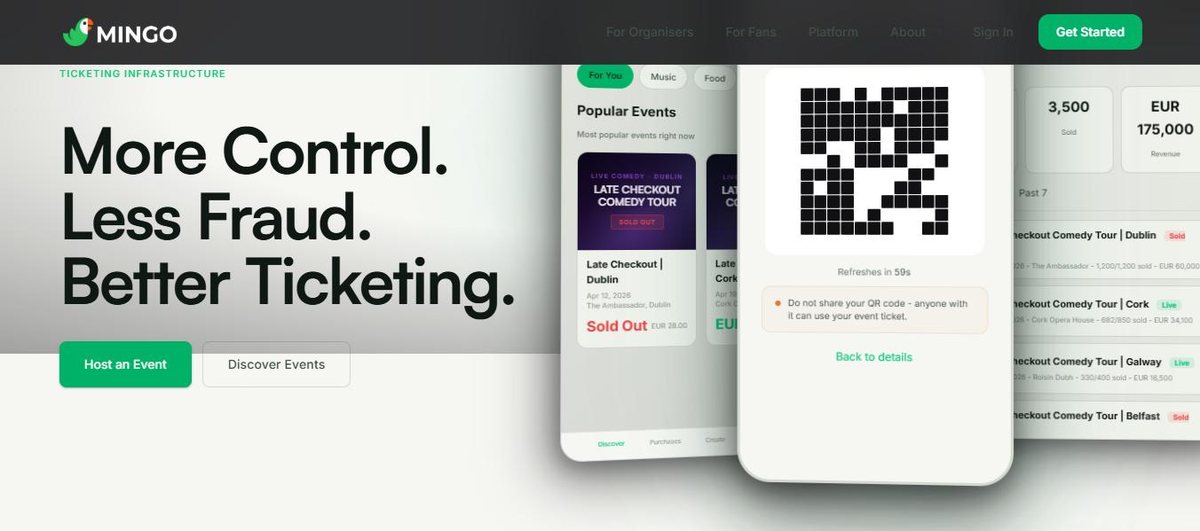
The hero carries the real interface — event listings, a live QR ticket, an organiser dashboard with sales figures. For a platform, showing the actual screens answers more questions in two seconds than a paragraph does in thirty.
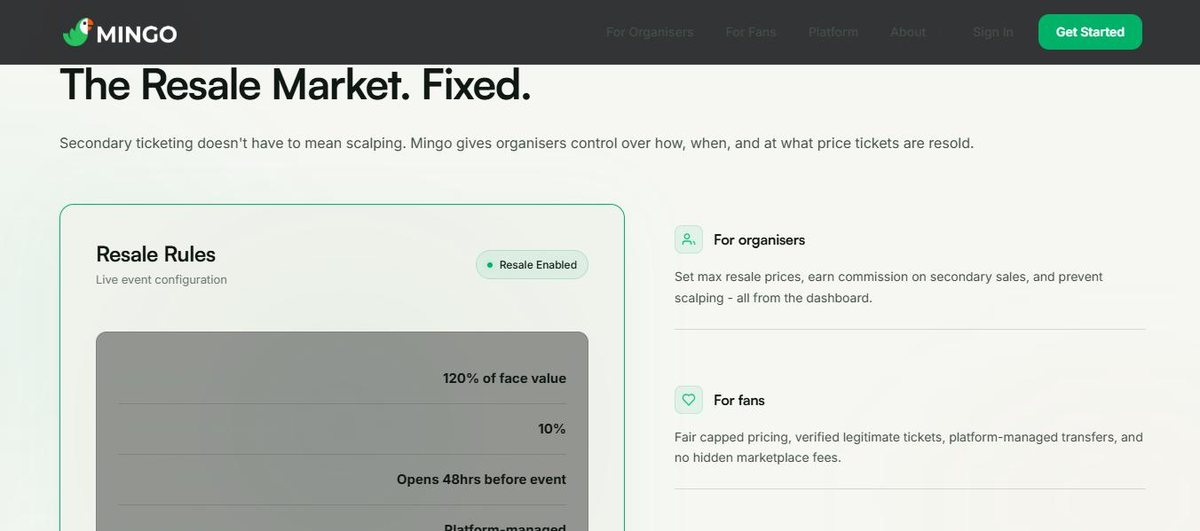
The resale section does not claim fairness, it shows the controls: price capped at 120% of face value, 10% organiser commission, resale opening 48 hours before the event. Stating the rules is what makes the promise credible to both sides at once.
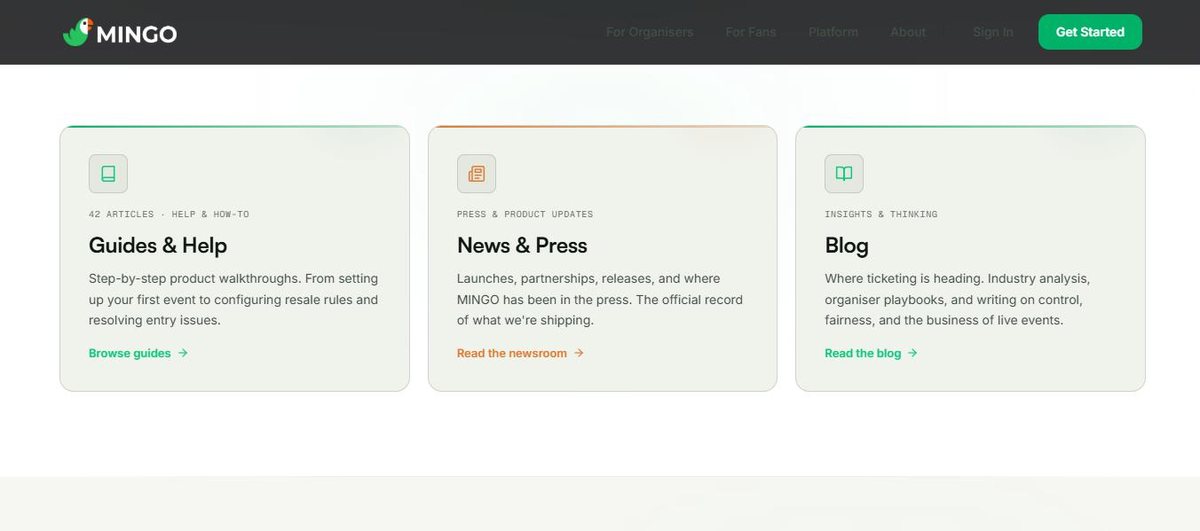
Resources splits into three streams: step-by-step guides, press and product news, and longer-form industry writing. Someone stuck at the door needs a different page from someone evaluating the platform, and both are different from a journalist.
The SEO
Most ticketing searches are not people shopping for a platform. They are organisers mid-problem — working out how to set resale limits, scan at the door, handle a refund — and fans trying to resolve something before an event starts.
So the content programme is built on the help centre rather than beside it. 42 published guides answering the operational questions people actually type, each one a page that can rank, and each one useful to a customer who is already paying.
On the technical side the site carries Organization structured data, Open Graph tags across pages, and a clean URL structure that separates the two audience paths from the resource library.
Create your first event in 10 minutes
Configuring resale rules & price caps
My QR code will not scan at the door
Refunds, transfers & cancelled events
Connecting Mingo to your CRM
Pricing tiers & timed releases
Results
The search report is being compiled. These slots stay empty until the real figures land, so every number on this page can be traced to its source.
AWAITING DATA
Source: Search Console
AWAITING DATA
Source: Search Console
AWAITING DATA
Source: Search Console
AWAITING DATA
Source: Search Console
AWAITING DATA
Source: Search Console
AWAITING DATA
Source: Search Console
Scope
Website design & development
Product-focused UX
Dual-audience information architecture
Conversion optimization
Technical SEO
Content & keyword strategy
Help-centre content programme
Free 30-minute audit
Platforms, marketplaces and anything two-sided share this problem: the pitch that convinces one side can unsettle the other. It is solvable, but it is a structural decision, not a copy tweak.